⋅•⋅⊰∙∘☽༓☾∘∙⊱⋅•⋅
Jenny Wolfe
⋅•⋅⊰∙∘☽༓☾∘∙⊱⋅•⋅
❝ Fan the flames of your passion.
Make them dance. Make them soar. ❞
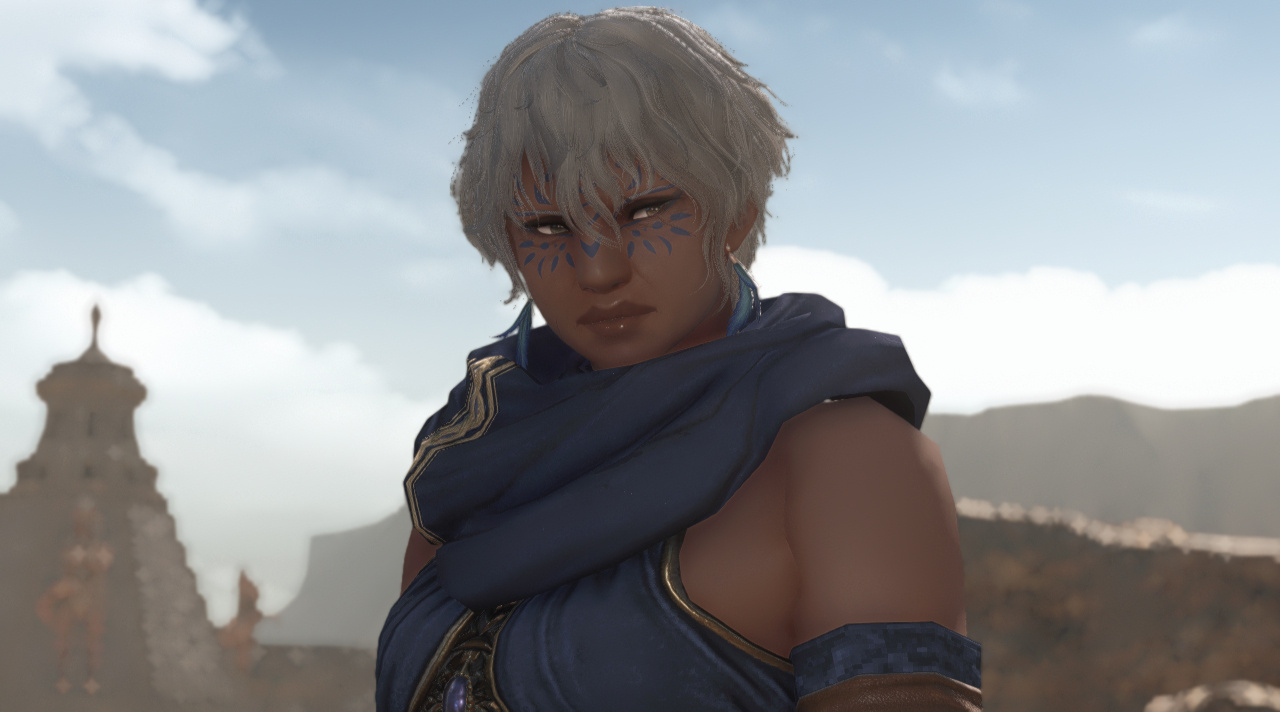
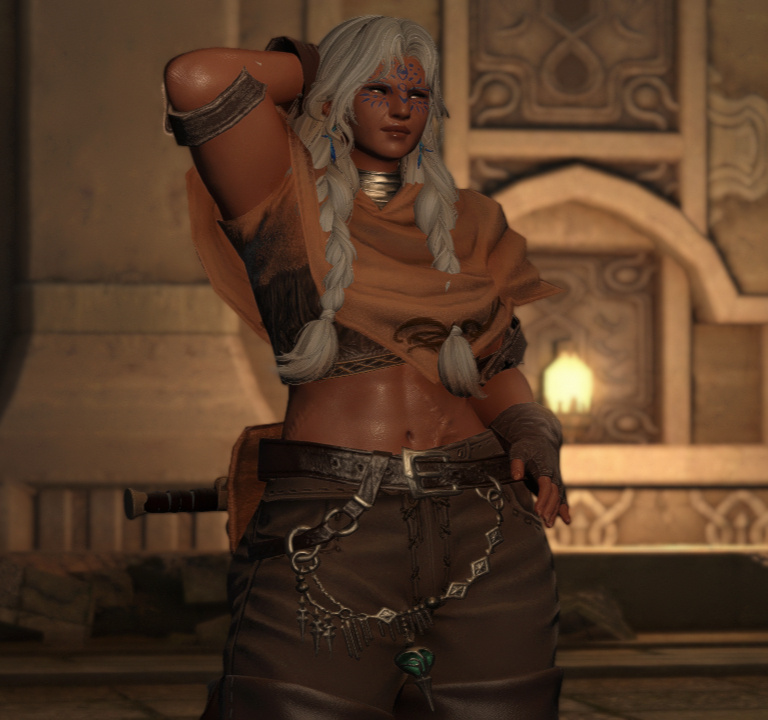
A tough, old broad hailing from the northernmost reaches of the western continent, possessing decades of adventuring experience as well as a heritage shrouded in mystery.
⪻───𖤓───⪼
dossier.
⪻───𖤓───⪼
· · ─ ·✶· ─ · ·
the basics.
· · ─ ·✶· ─ · ·
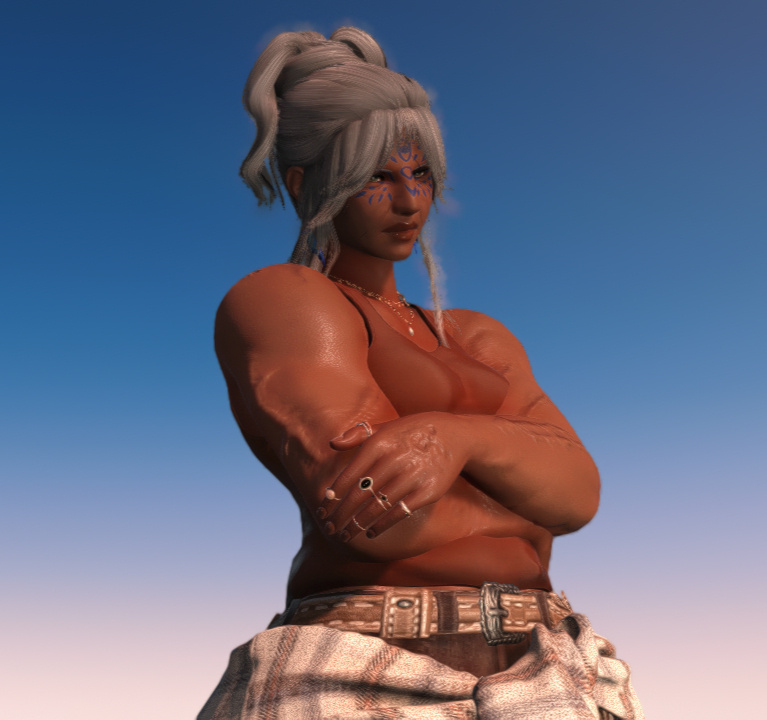
| name: | Jenny Wolfe |
| gender: | Cis Female |
| age: | 62 |
| race: | Hyur |
| ethnicity: | Whalaqee |
| sexuality: | Lesbian |
| height: | 5'7" / 170 cm. |
| birthplace: | Shaaloani, Xak Tural |
| typology: | ESTP 7w8 |
| status: | Single |
⪻───𖤓───⪼
dossier.
⪻───𖤓───⪼
· · ─ ·✶· ─ · ·
appearance.
· · ─ ·✶· ─ · ·
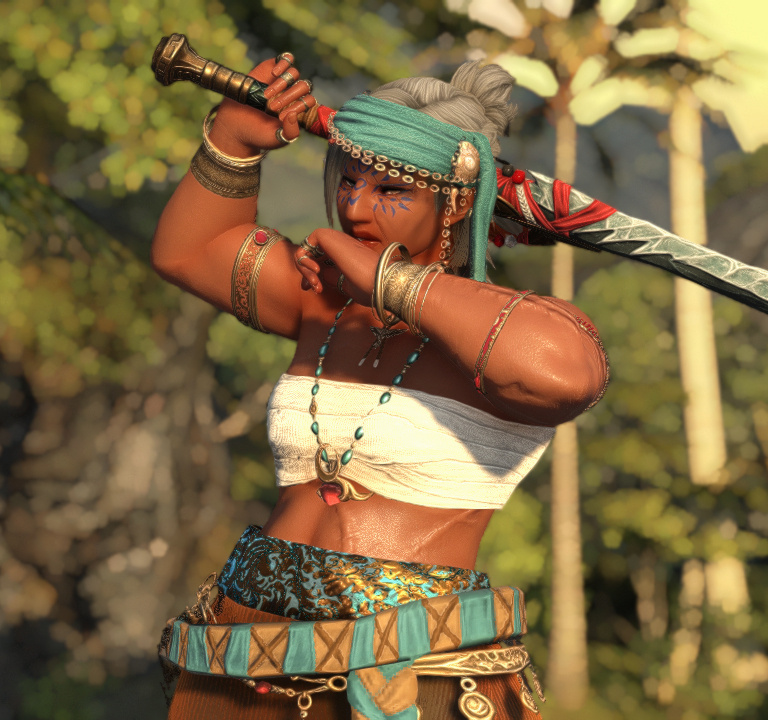
Before you is an elderly Hyuran woman of perhaps around average height; her bronze skin has experienced some wear and tear over the years, as evident by her wrinkles and the scars on her body. Despite this, her physique is most impressive, having managed to maintain her musculature for several decades. She's not as tough as she was in her prime, but she's by no means fragile and appears plenty capable of many feats of strength.Her once-obsidian hair has almost entirely turned a striking silver over the years, her wavy locks framing her heart-shaped face. Perhaps her most notable features are her slender, cat-like eyes, with the left being a bright hazel and the right a vivid green; they're perched atop her large, aquiline nose, and beneath that lies a charming pair of lips. They bring attention to her dimpled cheeks whenever they hint at some manner of mischief.As the color is considered sacred to her, she is wont to incorporate blue into her attire in some way. But in particular, she is always seen with blue paint on her face, its pattern also significant to her culture. With how often she is seen with it, one may mistake it as permanent.Her style of dress usually ranges from cultural to rugged, but can very well be something in between. She appears to be fond of accessories, some of which holding varying degrees of sentimental value. She can be seen toting around a large knapsack whenever she's traveling abroad.
⪻───𖤓───⪼
dossier.
⪻───𖤓───⪼
· · ─ ·✶· ─ · ·
personality.
· · ─ ·✶· ─ · ·
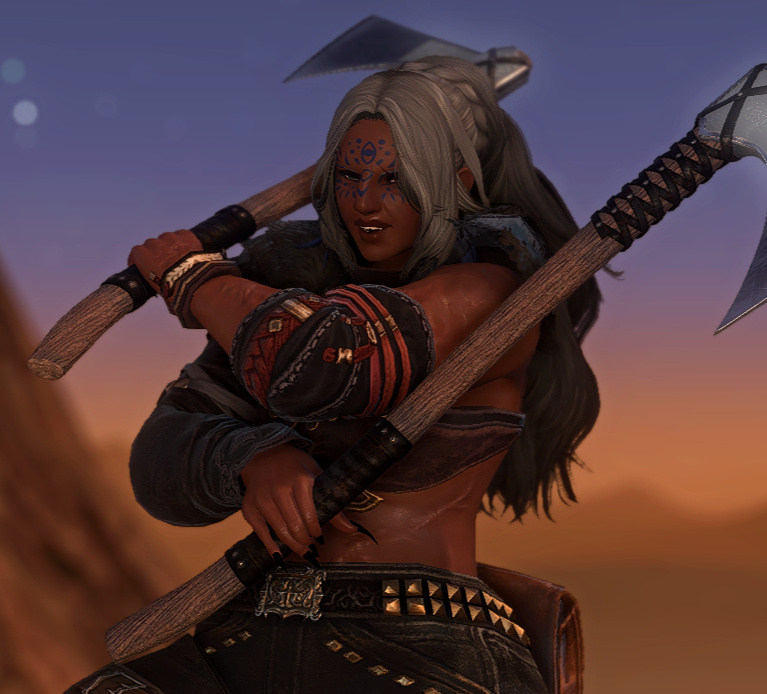
Jenny Wolfe, or so she calls herself, is nothing if not a woman of action. She lives her life loudly and without shame, unwilling to shrink in the spotlight or allow someone to dim it. She knows precisely who she is and what she wants, her wealth of self-confidence driving her to achieve more while staying true to herself.Jenny goes wherever she pleases and doesn't stay in one place for long; her unrelenting wanderlust makes her nigh impossible to tie down. She wastes no time in seeking the next thrill, and her boundless energy can rival that of some younger folks.She's become more of a people person after having built up an abundance of social savvy over the years. Jenny's been described as charismatic, and indeed, her down-to-earth authenticity contributes to her charm. She always seems to know the right words to get someone to laugh or smile.Despite this, she doesn't wear her heart on her sleeve, and very few are trusted completely; she doesn't form strong connections easily, but should one manage to create one with her, she is unlikely to let go of it.Jenny may have slowed in her old age, but she certainly has not stopped, as the same passion that burned in her heart decades ago remains to this day. Fiery, boisterous, and perhaps a little crass, she is sure to leave a lasting impression; she has plenty of stories to tell, and so long as she draws breath, she vows to create many more.
⪻───𖤓───⪼
dossier.
⪻───𖤓───⪼
· · · ─ ·✶· ─ · · ·
miscellaneous.
· · · ─ ·✶· ─ · · ·
"Jenny Wolfe" is not her real name but an alias she believes to be more palatable for native Eorzean speakers. She only reveals her true name to those closest to her.
She will frequently code switch between Eorzean and her native tongue, Whálàwhá. She will say plenty of unfamiliar terms.
She has an incredibly strong Shaaloani accent. She tends to be a chatterbox and is prone to rambling due to her age. Her filter has also declined with age, so her words are not entirely tactful at all times.
She has a remarkable sense of smell, and it's the keenest of her five senses. She tends to recognize scents more accurately than faces or voices, and she's more likely to retain information this way.
Jenny is a CODA, meaning she was raised by a deaf parent. She grew up learning sign language from her Deaf mother and may use it depending on the situation. This is also why she's very expressive when she speaks.
She is skeptical around Eorzeans and is much slower to trust them than those hailing from other nations. Historically, Eorzeans don't have the best relations with her people; she doesn't generalize, but she can't help but be wary.
⪻────𖤓────⪼
hooks & rumors.
⪻────𖤓────⪼
❛ A Woman of Many Names. ❜
Common;
After over forty years of adventuring, Jenny has made a name for herself. Several, even, and it depends on the company she keeps. From a pirate to a mercenary to a traveling performer, she's proven to be an adaptable member of many kinds of parties. You may recognize her.
❛ Name Your Price. ❜
Common;
Jenny is known to take up many leves and odd jobs to fill her time. Got a job that needs doing? She's happy to help, so long as you have something to give in return. Perhaps you've the coin, or you can barter.
❛ Let the Hunt Begin. ❜
Common;
As her tribe's brand of magic is sharpened through hunting, Jenny still constantly hungers for a challenge to put her skills to the test and deepen her knowledge. You may be a hunting partner, or perhaps her rival.
❛ Whálàye. ❜
Common;
Jenny is proud of her heritage and enjoys enlightening others about it. One curious soul may have questions for her, and if they're respectful, she may have an answer. However, there are a few details that she's forbidden to speak on.
❛ Bridging the Gap. ❜
Common;
Having traveled across the star for years, Jenny still finds something new to learn about others. She may be curious to learn of your culture, especially if you hail from outside of Eorzea.
❛ Steppe Sister. ❜
Uncommon;
If you were to ask, Jenny would claim that her favorite place to visit would be the Azim Steppe, and over the decades, it's become a home away from home. Those who frequent the Steppe may have seen her, and Xaela folks grab her interest.
❛ An Old, Old Friend. ❜
Uncommon;
You've known Jenny since she became a fresh-faced adventurer over forty summers ago. You haven't seen her in decades, but recently heard word of a traveler fitting her description. You may have history together, be it positive or negative.
❛ Wild Thing. ❜
Rare;
Those sensitive to aether may take notice of her signature. Her aether is abundant; one may wonder how she's contained it. If they're extremely keen, they may see it take a familiar, animalistic shape... and if they listen close, they may hear it make a sound.
‧₊˚ ⏾. ⋅
Common
"Can't remember her name, I don't think she ever told me. But if you're looking for her, you can't miss her. Has these blue markings on her face, you see. Some say they're enchanted."
"I may have caught her whittling something a while back. Most think whatever she's carving is supposed to hold dark magic. I personally just think she's an old bat with a hobby."
"I occasionally hear her claim that she's a 'mama to many'. A mother who's also an adventurer sounds... unlikely. Hells, at her age, she probably has grandkids, too. I don't know how she's got the time or energy to travel about. It's gotta be one of two things: either she's lying or she's a deadbeat."
Uncommon
"That kook held a whole conversation with a sun drake... and it was listening! Responding, even! My ears don't ever deceive me, I know what I heard. It must be some kinda witchcraft."
"The marks on her face are obvious, but I saw some on her hands and fingers, too. Couldn't really tell what they looked like because they disappeared as soon as I blinked. Maybe I was seeing things...? I need a nap."
Rare
"A weird old Hyur? Well, I suppose I've seen one swing by once. Didn't stay for too long, looked to be in a rush. Had all this dried blood on her maw. Don't know what the Hells that's about. But no matter the case, there's something dangerous about her... so I advise you steer clear."
‧₊˚ ⏾. ⋅
These rumors may be true or false, and you are also not limited to these! If you'd like to try the "Rare" hook/rumor or wish to brainstorm something else, talk to me and we'll see if we can make it happen.
‧₊˚ ⏾. ⋅
⪻─────𖤓─────⪼
lore expansion.
⪻─────𖤓─────⪼
*NOTE: This entire section is a massive WIP. Some information is currently available. A majority of this section will be homebrew, but it's meant to expand upon canon lore. I do not expect anyone to read through all this, it'd be cool if you did, but it's not necessary! There will be frequent updates, so check back often! Everything is subject to change.
Who are the Whalaqee?
— a brief overview of the elusive Hyuran tribe indigenous to the Lapis Canyon in Xak Tural.
Yíwhálà'ŧàǧì & Survival
— how the creators of ❛blue magic❜ actually use it, as well as its deep cultural significance.
Whálàwhá & Other Dialects
— a guide to the language of the Whalaqee, highlighting common words, phrases, and uses.
Family & Relationships
— how the Whalaqee navigate different social dynamics, as well as how children are raised.
Education & Professions
— how the Whalaqee preserve and pursue knowledge, and what constitues as a job.
Government & Justice
— details about the Whalaqee's leaders, how they are chosen, and how crimes are punished.
Fashion & Apparel
— details about what the Whalaqee wear, what they mean, and how they're made.
Leisure & Events
— what the Whalaqee do for fun, common hobbies they take up, and their holidays and festivals.
Food & Cuisine
— a look into Whalaqee recipes, what significance they hold, and when they're served.
Architecture & Landmarks
— how the Whalaqee live, what their cities look like, and several sites of importance.
Trade & Commerce
— the trade agreements and relationships the Whalaqee have forged with others.
Religion & Faith
— a glance at the Whalaqee's religious beliefs, such as their deities and their practices.
⪻───𖤓───⪼
overview.
⪻───𖤓───⪼
‧₊˚ ⏾. ⋅
The Whalaqee, which roughly translates to "soul people" in Whálàwhá, is a tribe indigenous to the lands of Xak Tural. They are known for their magic, their sacred Lapis Canyon, and their reverence of the color blue. But outside of these things, they are not a well-documented people due to being rather closed-off to outsiders and their home simply being difficult to reach; one may be hard pressed to find any information about these people even in the most expansive archives in Sharlayan. Regardless, theirs is a rich and unique culture with a fantastical yet lesser-known history, with their origins sounding akin to the tales of legends.
The ancestors of the Whalaqee can be traced back thousands of years ago during the Fifth Umbral Era. This ice age motivated a few hundred Hyur to start migrating to another, much warmer location. But with no end to the ice in sight, many of them began to starve or freeze; their arduous trek to the West had caused their numbers to dwindle, and it seemed as though they were on their way to dying out entirely.But such a grim fate never befell them because on their travels, they made an unlikely ally: a giant white wolf.Every lorekeeper and orator of the Whalaqee is different and may embellish the details here and there. But in every retelling of the story, the main idea remains consistent: the one that led their ancestors to their current homeland and introduced their magic to them was that white wolf.This legendary figure would be remembered for centuries by the name of Hàkwàdé'mélúsi, which roughly translates to "the one who sheds the blood of the moon". However, it can vary depending on the dialect.The wolf had claimed these migrants as its "children", binding their soul to each of them and officially uniting them under one name: the Whalaqee. The wolf provided protection and guidance to these people, as well as revealed a different way to harness aether to make the most out of the harsh climate.After many years of traveling and hunting with Hàkwàdé, the ancestors had finally reached what would be known in the modern day as Xak Tural. However, it wasn't until the very cusp of the Fifth Astral Era that the huge icecaps of this continent would melt away and the vast bodies of water left behind would dramatically shape the land into a large canyon.But this also meant that the wolf had fulfilled its duty, and when it died, it's believed that its vibrant blue blood seeped into the earth, giving the entire canyon its iconic hue and rich ceruleum deposits. This land, the Lapis Canyon, is considered by the Whalaqee to be a gift from above.It is small wonder why the white wolf and the color blue are seen as sacred in their culture. This story has been passed down from generation to generation and continues to be told throughout every era.
Hyur make up the overwhelming majority (~99.61%) of the Whalaqee population, save for some rare individuals that may be of mixed blood. With roughly 1.24 million people currently in the tribe, they do not make up a majority of Tural's population, but their numbers are steadily growing. They come in a myriad of shapes and sizes, sporting every kind of skin tone, hair texture, and facial feature.The one thing that distinguishes a Whalaqee from other Hyur is the rich blue jagua that they proudly wear on their faces, with multiple designs having different symbolism. They are seldomly seen without these markings. The most common of these designs is a vertical eye painted on the forehead, representing their ability to see the souls of beasts; this mark is believed to ward off evil and grant them protection because the White Wolf is watching over them.In this tribe, hunters also serve as mages, as it is through hunting that their magical ability is refined. While it is possible to train as one or the other, it is encouraged to be skilled in both. This makes them a rather versatile and hardy folk that would make them ideal for adventuring and mercenary work. Alas, their skills are usually not seen outside of the Canyon, much less outside of Tural. Regarding battlecraft, the Whalaqee do not discriminate on what weapons they create and use, but axes, tomahawks, bows, swords, lances, and knives tend to be favored.They are also shown to be inventive with their magic and use it outside of combat or academia. Many use it for art, textiles, architecture, and more; it is thanks to this ingenuity that led to their Canyon having gorgeous cities and beautiful handmade materials that would be far more difficult to make or obtain elsewhere. Another interesting use of this magic is through taming of beasts rather than hunting them.The official language of the Whalaqee is called Whálàwhá, or "soul tongue". Some aspects of this language borrows from their neighbors in Xak Tural, such as the Shetona. There are at least three different dialects among the Whalaqee. A select few communicate with a whistle language that is seen as divine, and it is used by chiefs and shamans to communicate with the heavens. Most Whalaqee recognize it when they hear it, but cannot understand it because it is not taught to those who are not religious leaders.They are a relatively friendly people overall, and very expressive. They are also active and enjoy moving about; even the elders are seen as rather energetic for their age. The Whalaqee tend to be longer-lived than most other Hyur, having an average lifespan of approximately 93 years; it is not unheard of for someone to live 10 or even 20 years longer. Some attribute this to the magic they use, others to their healthier lifestyle, but it could be a combination of both.As they live in Xak Tural, the Whalaqee in general are not very fond of cold climates. However, there are communities of this tribe that reside in the very peaks of the mountainous Canyon, and these few are more adjusted to such temperatures; some aspects of their culture also differ from the rest of the tribe's, like the game they hunt.
The Whalaqee are a proud tribe of people, but they're also rather isolated from the outside world. There was a time when they were willing to be more open and generous, but recent events left most of the population rather skeptical towards outsiders, especially Eorzeans. Most would rather not leave the Canyon, and the scant few that do rarely— if ever— travel to Eorzea.This is because it was Eorzean explorers that spread a disease all throughout the tribe, nearly leading to a genocide. And it was also an Eorzean that exploited this weakness, tricking the tribe's elders into signing a contract that would give them the antidote in exchange for their entire Canyon. Needless to say, the Whalaqee do not look at Eorzeans favorably, rightfully viewing them as oppressors and thieves. Consequentially, many of them viciously safeguard their culture from others, and adventuring outside of the Canyon is seen as dangerous. They never forget this part of their history nor do they allow others to do the same.This has led them, however, to being perhaps a little close-minded to other cultures, preferring to stick to what they know. There are a brave few, though, who hunger to venture outside of the Canyon's borders, craving to learn more about other people who call this word 'home'.
‧₊˚ ⏾. ⋅
⪻─────𖤓─────⪼
yíwhálà'ŧàǧì.
⪻─────𖤓─────⪼
‧₊˚ ⏾. ⋅
Yíwhálà'ŧàǧì, or "boundless soul of the earth" in Whálàwhá, is the magic that the Whalaqee are most known for. Utilizing the aether of the natural environment, this magic is viewed not only as powerful, but also as an important cornerstone of Whalaqee culture.Those residing in Eorzea may know yíwhálà as the "blue magic" featured in the Masked Carnivale that has but recently been introduced to the country. However, the Whalaqee strongly disapprove of the term as it implies allyship with their oppressors and erases the magic's deep cultural value. One must take care to never refer to a Whalaqee as a "blue mage".While this magic is considered new in other parts of the world, it is actually rather ancient. The ancestors of the Whalaqee discovered this magic towards the end of the Fifth Umbral Era, approximately 3,000 years ago. However, it was used sparingly until the Fifth Astral Era; just like most other magic, this was when it gradually became a more common practice.The Whalaqee's knowledge of yíwhálà runs exceptionally deeper compared to those practicing it elsewhere; however, it is claimed that they still don't know the depth of its power, despite how old it is. They continue to find new, inventive ways to utilize this magic that is not seen anywhere else... and are closely guarded secrets.
The earliest practices of yíwhálà were strictly for survival and nothing else. The Fifth Umbral Era was considered an ice age, and the Whalaqee's ancestors had to hunt down whatever sparse wild game was available; they used that aether to weave spells that would keep them warm at night and stave off their hunger. At first, it was the strongest Whalaqee that would do most of the hunting, but over time, this magic would be taught to others so that they may increase their chances of survival.The "blue mages" of Eorzea are known for casting spells with a cane, but this is actually a much more modern practice. The earliest Whalaqee had no weapons at their disposal for a long time; traditionally, it was their bodies that functioned as the magical focus. Aether was channeled through whatever limbs they possessed, typically their hands and fingers. These limbs would then mimic the physiology of a beast and were used to give them an edge in combat.To this day, many Whalaqee cast spells in the same way, but there are several other methods to evoke this magic. Actively imbuing this magic from their hands and into weapons has become a very common practice particularly for hunters because it is quick and practical. Chiefs and shamans have been known to use very elaborate staves, especially for ceremonial purposes. Totems are used in the same way magical tomes are, storing yíwhálà for later use; this is common for teaching the magic to others without the constant need to cast a spell and deplete one's aether.
It was through the soul of a beast that the Whalaqee were first introduced to yíwhálà, and it is through the souls of other beasts that they train and perfect it. When a beast is slain, the hunter can "read" its soul and consume their aether for themselves. This is not always a guarantee and it appears to be dependent on both the skill of the hunter and, to an extent, chance.Once that aether is consumed, however, the new skill will need to be practiced in order for it to grow stronger. Just like any other skill, the potential means nothing unless it is consistently sharpened. But once someone continues to practice that skill, the aether will no longer be latent and will instead intertwine with the person's natural aether; with more practice, spellcasting will feel like an instinct.However, this should only be done in moderation, as yíwhálà can be destructive to the wielder if used improperly or in large quantities over an extensive period of time. It is not unheard of for a Whalaqee's aether to corrupt to the point they become an uncontrollable, destructive force. These effects are permanent, and unfortunately, they must be killed.Moderation will always be key to prevent corruption, but the Whalaqee have developed other useful methods. The healers of the tribe are well-learned in spells of purification. Certain totems can be worn to ward off corruption, but must be replaced every so often; this is a common practice for hunters.Interestingly, yíwhálà has evolved to have different offshoots, with the most notable one involving the consumption of dłǔm'háyí (voidsent) aether. These spells serve more as curses and have devastating effects ranging from converting life force into mana to instant death. This magic can be used for good, but only the shamans are trusted to practice it extensively to protect the tribe.
‧₊˚ ⏾. ⋅
⪻────𖤓────⪼
disclaimers.
⪻────𖤓────⪼
‧₊˚ ⏾. ⋅
This will be the longest and most in-depth portion of the Whalaqee lore. It is a huge personal project and will likely always remain a WIP due to its expansiveness; many aspects of this section can and will be tweaked, added, or removed, so updates are frequent.
As the Whalaqee are heavily inspired by Indigenous people, I crafted their language using elements from the following Indigenous languages: Havasupai, Lakȟótiyapi (Lakota), Diné Bizaad (Navajo), and Hopilàvayi (Hopi). This list may change over time.
Assuming most people reading this are English speakers, I challenge you to not approach this language as though it were English. It does not look, sound, or behave like the English language; the phonology, orthography, and grammar structure may be difficult to grasp, but I find keeping an open mind will make it easier to do so.
To my knowledge, none of these words exist in any language nor are any of them officially canon; while the sounds themselves are real, I created the actual words and phrases entirely on my own. However, I am no polyglot and I don't know every language, so there may be similarities. Please understand that this isn't intentional.
I try to implement these words throughout roleplay. However, keep in mind that every word I create may not actually be used in it. Do also keep in mind that certain words said through roleplay or typed in this Carrd can and will change over time to better suit any modifications I make to the language.
I am Black in real life, but not Indigenous. I dig deep into research on any culture that I'm inspired by, but I understand I may get something wrong or portray that culture insensitively. I always welcome and appreciate any feedback or ideas particularly from Indigenous players. I am always willing to learn, and being respectful is my main priority.
‧₊˚ ⏾. ⋅
The alphabet is all that's published as of now, but more information will be written soon!
‧₊˚ ⏾. ⋅
⪻──────𖤓──────⪼
whálàwhá vowels.
⪻──────𖤓──────⪼
‧₊˚ ⏾. ⋅
| Vowel | Pronunciation |
|---|---|
| a | as in father |
| aa | same as a, but held longer |
| e | as in the Spanish peso |
| ee | same as e, but held longer |
| i | as in sheet |
| ii | same as i, but held longer |
| o | as in hope |
| oo | same as o, but held longer |
| u | as in ruby |
| uu | same as u, but held longer |
| aŋ | as in money, nasalized |
| aaŋ | same as aŋ, but held longer |
| iŋ | as in pink, nasalized |
| iiŋ | same as iŋ, but held longer |
| uŋ | as in raccoon, nasalized |
| uuŋ | same as uŋ, but held longer |
| Diphthong | Pronunciation |
|---|---|
| aw | as in cloud |
| aaw | same as aw, but held longer |
| ay | as in kite |
| aay | same as ay, but held longer |
| ey | as in fate |
| eey | same as ey, but held longer |
| uy | as in buoy |
| uuy | same as uy, but held longer |
Whálàwhá is a tonal language, in which every syllable has its own tone. The way vowels are spoken and written play a huge role in the language; using a different tone for a single syllable can change the meaning of a word entirely.There are four tones: neutral, high, low, and falling-rising. These are all indicated by a diacritic above the vowel, with the only exception being the neutral tone. While this tone could have a diacritic in some dialects, it is most commonly written without one. These diacritics are also used on long vowels and diphthongs alike; in long vowels, the diacritc is written above both letters to indicate that it's a single syllable with tone. Examples are shown below:
| Examples | Tone |
|---|---|
| a, aa, aŋ, aaŋ, aw, aaw | neutral tone |
| á, áá, áŋ, ááŋ, áw, ááw | high (rising) tone |
| à, àà, àŋ, ààŋ, àw, ààw | low (falling) tone |
| ǎ, ǎǎ, ǎŋ, ǎǎŋ, ǎw, ǎǎw | falling-rising tone |
‧₊˚ ⏾. ⋅
⪻───────𖤓───────⪼
whálàwhá consonants.
⪻───────𖤓───────⪼
‧₊˚ ⏾. ⋅
Diacritics are also used in consonants, but these letters represent completely different sounds altogether. Sometimes, consonants are silent, such as in the word Whálàwhá; the first h in this word is silent, but not the second. Keep in mind that some of the consonants listed here do not exist in English and have no equivalent. Some are harder to perceive than others. I will try to describe them as best I can.
| Consonant | Pronunciation |
|---|---|
| b | as in ball |
| č | as in chair |
| čh | same as č, but with aspiration, as in catch her |
| d | as in dog |
| f | as in fern |
| g | as in gift |
| ǧ | a guttural g sound, like the French r |
| h | as in honey |
| ȟ | a guttural h sound, as in Mexico |
| j | as in jump |
| k | as in keep |
| kh | same as k, but with aspiration, as in block him |
| kȟ | k + ȟ sounds together; no English equivalent |
| kw | as in quiet |
| l | as in lemon |
| ł | voiceless l sound; no English equivalent |
| m | as in mint |
| n | as in night |
| ñ | as in canyon |
| p | as in pepper |
| ph | same as p but with aspiration, as in up here |
| pȟ | p + ȟ sounds together; no English equivalent |
| q | similar to k, but with the tongue further back in the mouth |
| s | as in sun |
| š | as in shimmer |
| t | as in tank |
| ŧ | as in stick, but with tongue touching the teeth |
| th | same as t, but with aspiration, as in wet hair |
| tȟ | t + ȟ sounds together; no English equivalent |
| v | as in viper |
| w | as in winter |
| y | as in youth |
| z | as in zebra |
| ž | as in azure |
| ' | glottal stop, as in uh-oh |
‧₊˚ ⏾. ⋅
⪻──────𖤓──────⪼
whálàwhá grammar.
⪻──────𖤓──────⪼
⪻────𖤓────⪼
dictionary.
⪻────𖤓────⪼
*NOTE: This entire section is a massive WIP. Some information is currently available, and there will be frequent updates. Check back often! Everything is subject to change.
In addition, while a majority of the lore in this section will be of my own headcanon, it's meant to expand upon real lore stated in-game. I do not expect anyone to read through all of this, it'd be cool if you did, but it's not necessary!
Common Greetings
Pronouns 🙵 Tenses
Emotions 🙵 States
⪻───𖤓───⪼
occupations.
⪻───𖤓───⪼
‧₊˚ ⏾. ⋅
Šúɲbé'áqii: They Who Are Tireless
This group of Whalaqee responsible for gathering resources for and protecting the tribe. Their physical and martial prowess is what sets them apart, and if you're in need of a mercenary, a bodyguard, or another job that requires said prowess, these are the folks who will provide it. They work closely with the merchants and craftsmen, and many of the šúngbé'áqii are also a part of that social class. They are perceived as brave, valiant, and relentlessly energetic, their love for battle never seeming to wane. These are your hunters, gatherers, soldiers, and beastmasters. Due to the nature of the Whalaqee, this is perhaps the largest group, and doubtless some of the most formidable in combat.
Pȟ'wàjúúqii: They Who Make Plenty
This is the group of Whalaqee responsible for crafting what is gathered. If you're in need of a weapon, some clothing, or a meal, these are the people to seek out. They are perceived as a resourceful and hardworking folk, frequently having work to be done. They work closely with all other social groups but especially hunters, who provide them their resources; quite a few folks in this group are hunters themselves, and may even start their own businesses. You are likely to find pȟ'wàjúúqi hammering metal into the shape of a blade, selling food at a stall, or chiseling the finishing touches on a temple. These are your artisans, smithies, and architects; they enjoy working with their hands and making the most with what they're given.
Àyetùíqii: They Who Nurture
This is the group of Whalaqee who specialize in taking care of others in some way. If you're in need of some healing, some assistance with child-rearing, or simply need someone to talk to, these are the folks who can provide. They are perceived as kind, friendly, and motherly, as their jobs revolve around nurturing others. They also work with every other social group since there is always a need for them in any setting. Despite sounding female-dominated, there is a fairly even amount of men and women in this class along with many who identify as both or neither gender. These are your healthcare, childcare, and assisted living professionals; they pride themselves on helping others live full lives.
Dłùyòòčáqii: They Who Glimmer
This is the group of Whalaqee whose purpose lies in creating art for others to enjoy. If you want to witness how colorful the Whalaqee's culture is and see that come to life, there are a number of events hosted by these folks. Perceived as creative, lively, and emotional, these people keep their culture alive through their art; in many other societies, this line of work may not be seen as profitable, but it is strongly praised amongst the Whalaqee. If they are not also craftsmen themselves, they work very closely with them. Be it visual, culinary, or performing arts, these are the individuals who showcase the beauty of their people in both traditional and innovative ways.
Wotȟèyčhíqii: They Who Preserve
This is the group of Whalaqee who dedicate their lives to guarding and synthesizing knowledge. If you're looking to satiate your curiosity about any aspect of their culture, these are the people you must consult. These individuals are generally perceived as intelligent and bright, but there are always a myriad of different personalities working with academia. They tend to also be very stingy with information particularly to outsiders to prevent their culture from being stolen, bastardized, or forgotten. They don't work too closely with other social classes. These are your teachers, scholars, lorekeepers, and even economists; they preserve and pass down knowledge to keep their identity and their history intact for many years to come.
‧₊˚ ⏾. ⋅
⪻───𖤓───⪼
religion.
⪻───𖤓───⪼
‧₊˚ ⏾. ⋅
Creator of All Life.
Also called Ma Melu, or Mother Moon, this is the chief deity of the Whalaqee. She is depicted as a tall, rubenesque woman with long, wavy, blue hair. However, her most intriguing features are her six arms and the one large eye in the middle of her face. In each of her six hands is one of the six elements, or the avatar of each element. The one eye represents peering into the souls of both man and beast. In Whalaqee legends, she is said to be a benevolent, kind mother to her people. She is also the goddess of transformation, given the moon's many stages.
‧₊˚ ⏾. ⋅
Savior and Protector of Man.
Depicted as a giant, white wolf, this is one of the most prominent figures amongst the Whalaqee. Said to have been weaved from the moon's own blood, they serve as the ever-watchful spirit of the tribe. Some few thousand years ago, they possessed a physical form, and when that vessel died, the moon's blood within them gave the Canyon its color. However, they continue to reign in the spirit realm and are responsible for carrying out the moon's will. They are said to be a fiercely protective and loyal spirit.
‧₊˚ ⏾. ⋅
Avatar of Fire
Avatar of Water
Avatar of Wind
Avatar of Ice
Avatar of Lightning
Avatar of Earth
‧₊˚ ⏾. ⋅
King of Demons. Grand Deceiver. Destroyer of Peace.
⪻────𖤓────⪼
connections.
⪻────𖤓────⪼
‧₊˚ ⏾. ⋅
Priscille Fontaine
Early-mid 20's. Deceased.
A young Elezen noble hailing from House Fontaine in Ishgard. She had a notoriously hotheaded and bratty attitude, and she'd made her fair share of enemies. But she'd taken a liking to Jenny, to the point where she considered her family; they were dear to each other, despite their differences. Unfortunately, Priscille had picked a fight with the wrong man, and ended up paying the ultimate price. Jenny will always miss her, despite the reputation she'd built.
Savage Oak
Late 30's. Alive.
A Hellsguard man from Abalathia's Spine who was formerly under Priscille's employ as a bodyguard, but left it before her passing. An overall kind and honest sort, he and Jenny built a friendship fairly quickly. While they've since naturally drifted apart, Jenny does think of him sometimes.
Saya Kawanami
Early-mid 20's. Alive.
A young Au Ra samurai and assassin who was also under Priscille's employ as a guard. Jenny will admit that she knows very little about this woman, mostly due to her cold demeanor that could make anyone uncomfortable. She was fiercely loyal to Priscille in life, and they had eventually began dating. It would be a stretch to call Saya and Jenny friends, but their relationship is amicable.
Sabrina Fontaine
Mid-late 20's. Alive.
The older sister of Priscille Fontaine. When news had spread about her sister's death, she made her way to Ul'dah to find Jenny and grieve with her. However, she had also come for revenge on her murderer, which Jenny warned would be unwise. Once that revenge was enacted, Sabrina and Jenny's relationship had soured. She does not think too highly of this woman nor House Fontaine, for that matter.
Wulfrik Blacke
Mid-late 60's. Deceased?
An elderly Highlander man whose mysteries died with him. This was Priscille's murderer, though Jenny remembers him as an ornery old man who was defending himself. They didn't get along all too well when they first met, but formed a sibling-like bond after Priscille's death. While Jenny held some bitterness, she realized he may have been justified to a degree. They weren't ever terribly close, but she believes that he didn't deserve his end.
Captain Hesher Graves
Mid-late 30s. Alive.
A Midlander man with a mind as sharp as his tongue, Jenny has formed a rather strong allyship with this mage in recent times. He's a mysterious Lominsan who isn't keen on saying more than what's necessary, but he's shown to be more than what he portrays. His arcane proficiency and hunger for knowledge never fail to fascinate her. They share a mutual respect and curiosity for each other, so they cross paths frequently. He's become a good friend —and perhaps something like a son— to Jenny.
Swooping Griffin
Late 30s. Alive.
A Hellsguard man from Ul'dah with a personality as big as his stature. He's the kind of person who has no qualms making his presence known, which is likely a reason why he and Jenny clicked as quick as they did. She soon found Griffin to be fun and, at one point, even attractive company. Despite their chemistry, nothing came of it; but they are still close friends who have plenty of synergy.
‧₊˚ ⏾. ⋅
Develop a notable bond with Jenny and you may find your character's name written here!
‧₊˚ ⏾. ⋅
⪻──𖤓──⪼
gallery.
⪻──𖤓──⪼


⪻─────𖤓─────⪼
rules & guidelines.
⪻─────𖤓─────⪼
You MUST be 21+ to roleplay with me, no exceptions. I strongly prefer for your character to also be 21+; if not, our interactions will be extremely limited.
I have 10+ years of roleplay experience and I consider myself to be literate. Para and multi-para are preferred, but I can match your style. Our roleplay can take place in-game or in Discord, but I prefer the former.
I am a slow typer, though I am trying to get better at it. I am a grad school student, so my responses may not always be timely. Please give me some grace, and I will extend the same to you.
Yes, I use Light. We can trade codes if you're not weird and we're actively roleplaying. While mods could enhance the experience, they're not required for roleplaying with me.
I am a lore bender with a ton of homebrew stuff, but please don't use what I've written to metagame. Completely breaking the lore or being OP without reason/limitations sucks the fun out of roleplay. Super high tech aesthetics or scenarios (eg. Solution 9) do not interest this character.
I am open to pretty much any genre, especially adventure, mystery, and slice-of-life. I have no triggers, but excessive gore makes my skin crawl.
I am fine with my character getting injured, but nothing too extreme unless it was discussed beforehand. Also, do not rush her death, she's halfway to the grave already.
NO ERP. I'm not against it for her, but story will ALWAYS come first. If all you want from her is a quick bang, don't bother. I also have other criteria in place as I'm a little picky about her relationships. Please ask before trying any romance with her.
The attempted genocide and colonization of the Whalaqee is CANON LORE and therefore important to both me and my character. I refuse to avoid or tone down these and other such topics. If this discomforts you, I advise you look elsewhere.
I don't tolerate bigotry. Racists, homophobes, transphobes, misogynists, etc. have no place in either my or my character's social circle. If you're a Garlean, keep that imperialism away from me. Furthermore, IC ≠ OOC. If you have an issue, please tell me so we can fix it!
⪻─────𖤓─────⪼
social dynamics.
⪻─────𖤓─────⪼
‧₊˚ ⏾. ⋅
Family
When a child is born, it is something to be celebrated. It was customary for the parents to present the child to a shaman, who then performed a ritual to read the child's soul; the ritual used divination to foretell the child's destiny. It is through this ritual that the shamans would grant the child their name, which is perceived by most as sacred.This practice, while still encouraged, is not as enforced upon the younger generation; more and more new parents are deciding to name their child themselves and let them find their own destiny instead of consulting a shaman. Because of this, some younger Whalaqee tend to have shorter names than their elders. They are also less likely to hide their true name from outsiders.The phrase "it takes a village" rings very true for the Whalaqee when it comes to child-rearing. There are clans within the tribe, and each clan has a number of different families populating it. Some clans are bigger than others. More children usually means a bigger clan, which is seen as prosperous. Most Whalaqee households, especially older ones, have at least two children. It is rare for a Whalaqee to be raised as an only child. But odds are they have many aunts, uncles, and cousins to interact with regardless.Unless it's dictated otherwise, all parents are to share responsibility within the household, regardless of gender or orientation. They are seen as equal, just as the sky is equal to the earth. In the past, whoever hunted the most game would be deemed as the head of the house, but nowadays, it's more important that every parent provides whatever care and support they can for their children. Adoption is a common practice among those who cannot have biological children. It is also not unheard of for a child to be born in one clan, but is adopted and raised in a different one.Whalaqee children tend to be louder and more energetic compared to other Hyuran children. They have an almost dangerous amount of curiosity if they're not being watched. It is a given for other families to help raise them alongside the parents. Teaching them how to hunt from an early age is a necessary skill; they won't be accepted as adults until they've successfully undertaken a certain trial revolving around hunting.
Friendship
Most people a Whalaqee will befriend in their lifetime will be from the same clan, but there are plenty of opportunities for them to meet and mingle with others outside of it. This is particularly true during festivals when all the clans celebrate the holidays together.Friendship is very important to the Whalaqee; being able to rely on others in time of need is something they value greatly. Being involved in or creating your own community is encouraged among them. Most Whalaqee, in general, can certainly be described as extroverted and many are able to befriend others quickly. If one were to meet a Whalaqee, there is a high chance they're talkative.Of course, there are many introverted Whalaqee, as well. Chances are, there's an extrovert who's willing to take them under their wing; after all, companionship is valuable in all its forms. While they're a fairly accepting people overall, there is a problematic, unspoken double standard among the Whalaqee that tends to see introversion as something that should be remedied. A great many of them instinctively agree with this view, even if they don't realize it. If an introvert were to meet a Whalaqee, they may be pushy about getting them to open up more. This is not meant to offend, and they can learn to accept people as they are.If a Whalaqee calls someone a friend, they treat them like a clanmate even if they belong outside their clan or tribe. They tend to make for fierce, bold friends, especially if they're particularly close with someone; while they may make plenty of friends over time, they're rather close-knit and value depth in their friendships. They're a physical people, cuturally, and even some of the quietest Whalaqee can be physically affectionate. Gestures like hugs and hand-holding are seen as very normal between friends.
Romance
Whalaqee relationships are predominantly monogamous in nature, but polyamory and polygamy are not unheard of, especially in bigger clans. While everyone's individual experiences ultimately shape their preferences, the Whalaqee tend to gravitate first towards those with great courage and strength; it was believed that these people would make the ideal parents and pass these traits down to their children. While this is a more archaic view nowadays, it was prevalent not so long ago.As this is a tribe full of hunters, it is small wonder why many courting practices also involve hunting. While it varies from person to person, a Whalaqee's preferred love language is likely to involve gift giving or acts of service. Hunting the biggest game for their partner and crafting goods from the carcass is a common courtship ritual, but this is just one of many.There are a number of gestures that may indicate a deep romantic connection. Doing their partner's hair can be seen as intimate as hair is considered sacred to them. Sexual relations outside of marriage has steadily become less stigmatized, but it is given great caution. To many Whalaqee, the sharing of bodies is one of the most intimate acts one can do; there will always be exceptions, but rarely do they engage in this act without some attachment.The strongest indicator of attraction, however, is seeing each other barefaced, which is considered extremely intimate and vulnerable. A Whalaqee applying jagua to their partner's face can be considered a love confession or a marriage proposal depending on the design. It is meant to replicate how the wolf bound its soul to its people, and how that person is now considered a part of their own family.Marriage is seen as the sacred act of binding one's soul to another's, becoming a single unit with a shared destiny. Marriages between clans, while not necessarily outlawed, are not terribly common. Due to the homogeneous racial makeup of the Whalaqee and the vicious protection of their culture, marriage between different races or even other Hyur is an extremely rare occurrence. However, Whalaqee that travel outside the Canyon's borders are far more likely to bind themselves to someone who is not of their tribe or race.
Enmity
For the most part, the Whalaqee are an honest, direct people. If they are not on good terms with someone, they are bound to make that dislike clear. Obviously, there are a great many reasons for why a relationship of any kind will have a falling out, but the most common is disloyalty. Betrayal is seen as cowardly and disgraceful; as they value community, they take these actions more seriously than most other folk.Most Whalaqee would agree that it is far better to address an issue with someone else before it breeds further resentment. If they start to have a problem, they'd rather talk about it; the ideal outcome is that they'd overcome their differences and perhaps become friends or at least tolerate each other. But there are many who are non-confrontational, and even if that's not the case, talking might not always work.In the case of the latter, they may consider each other enemies. It may persist for a while, but it may resolve itself over time since that is said to heal all wounds. But some wounds cut deep, and if the community notices that there is an abundance of hostility to the point where it's disorienting to others, they may suggest taking out their frustrations through combat. Such a fight persists until both parties have made their grievances known; there is no true winner or loser. They may or may not cut their losses afterward, but the goal is to clear the air and release all their hatred.
‧₊˚ ⏾. ⋅